
“The lithium battery industry has navigated multiple market cycles. Intelligent equipment providers must adopt tailored strategies at different stages. During upward cycles, companies must seize opportunities for rapid expansion. During market adjustments, they must not only protect their core fundamentals, but more importantly, execute cross-cycle strategies to prepare for the next growth wave.”
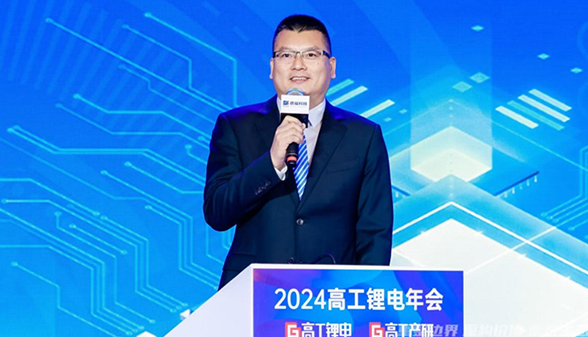
Fu Wenhui, Chairman and General Manager of SKQ, shared these insights during his speech at the 2024 Gaogong Lithium Battery Annual Conference.
Understanding Market Cycles and Long-Term Trends
As Fu highlighted, the new energy vehicle (NEV) sector has experienced dramatic shifts—from overcoming early market penetration hurdles to navigating the 2019 downturn, post-pandemic acceleration in 2020, market highs in late 2022, and the growth moderation in late 2023. Correspondingly, the lithium battery value chain has experienced cycles of capacity expansion, supply-demand mismatches, and price fluctuations.
Despite short-term volatility, long-term fundamentals remain exceptionally strong. China’s annual NEV production exceeded 10 million units for the first time in November 2024, and GGII projected global lithium battery shipments to surpass 1.1 TWh for the year.
Fu believes that while the lithium battery sector holds immense promise, it is also defined by rapid technological iteration and fierce market competition. Equipment makers can only preserve their competitive edge and maintain industry leadership by embracing Long-Termism.
To Fu, Long-Termism is far more than a corporate slogan—it is a strategic roadmap. It requires sustained, cross-cycle investment across technical R&D, product diversification, supply chain integration, and global expansion.
SKQ’s Four Core Strategies for Cross-Cycle Growth
1. Technical Innovation & Deep R&D Accumulation
Innovation forms the backbone of SKQ’s long-term philosophy. Building on its “150D Full-Capacity Plan” launched in 2022, SKQ has continuously advanced its tech-driven strategy.
This year, SKQ introduced a forward-looking equipment manufacturing standard characterized by “Standardization, Miniaturization, Plug & Play (P&P), and High Reliability,” directly addressing market demands for high-speed, high-quality production.
For instance, SKQ’s P&P-compliant Automated Overhead Hoist Transport (OHT) system delivers high-speed automation and precise control at a cost comparable to semi-automated alternatives. Furthermore, technical optimizations in side-seam welding fixtures, tooling, and electrical systems have significantly boosted equipment stability and throughput.
By adhering to a “Market-Led, Tech-Driven” R&D model, SKQ collaborates closely with top-tier battery makers to co-develop new processes and pioneer next-generation technologies.
2. Product Diversification & Comprehensive Portfolio
To address evolving customer needs and mitigate market risks, SKQ has systematically expanded its product portfolio beyond its established leadership in battery module and PACK lines.
The company now provides cell-level equipment, including Inline CT Inspection Systems, Laser Flying Welding Workstations, OHT Systems, Visual Line-Scan Systems, and Automated Recycling/Dismantling Equipment.
Additionally, SKQ offers integrated hardware-software ecosystems through its proprietary sub-brands:
Kopaile: Intelligent logistics and automated material handling.
Qihang Technology: Industrial software, MES, and digital factory solutions.
3. Strategic Supply Chain Synergy
SKQ collaborates closely with world-class component suppliers such as TRUMPF, KUKA, and Siemens, guaranteeing cutting-edge technology integration and supply chain reliability for core components.
Through internal supply chain optimization, SKQ delivers complete, end-to-end automation solutions—spanning raw material feeding and automated transfer to multi-station processing and automated warehousing.
4. Global Expansion & Localized Networks
In response to the global expansion of the lithium battery industry, SKQ is accelerating its international footprint and building localized service networks to serve global partners.
In 2024, SKQ established its Hungarian subsidiary, bolstering its local service and support capabilities across Europe. Today, SKQ’s intelligent equipment serves clients across Europe, North America, and Southeast Asia.
Looking Ahead
Fu emphasized that “Standardization, Miniaturization, Plug & Play, and High Reliability” will become the universal consensus for next-generation intelligent equipment. SKQ has already deployed these modular standards across multi-station systems, earning widespread customer acclaim.
Moving forward, SKQ will remain committed to its core philosophy—“Market Leadership, Technology Guidance, and Collaborative Innovation”—deepening its integration into global supply chains and empowering the global energy transition with sustainable innovation.